Evaluating the Practical Value of OM Laser Cut Wall Decor Design
In the evolving landscape of digital fabrication, the intersection of spiritual symbolism and modern manufacturing techniques offers a unique avenue for creators. The OM Laser Cut Wall Decor Design represents more than just a decorative asset; it is a functional resource for those working with laser cutters, CNC routers, and digital cutting machines like the Cricut. For professionals and serious hobbyists alike, understanding the technical specifications and creative potential of such designs is essential for producing high-quality, marketable products.
This analysis explores the utility, file compatibility, and design integrity of the OM Laser Cut Wall Decor, focusing on how its layered structure and diverse file formats support various workflows. Whether you are a small business owner looking to expand your home decor inventory or a DIY enthusiast aiming to personalize living spaces, evaluating the underlying assets is crucial before committing to production.
The Appeal of Layered Laser Cutting in Spiritual Decor
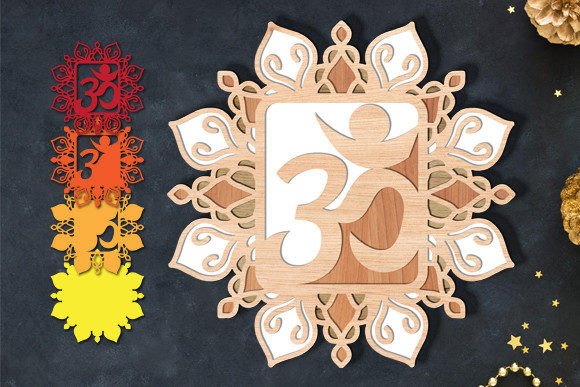
Layered laser cutting has emerged as a dominant trend in wall art due to its ability create depth and visual interest without requiring complex assembly techniques. The OM Laser Cut Wall Decor design leverages this technique by utilizing multiple layers of material—typically wood, acrylic, or MDF—to construct a three-dimensional representation of the Om symbol. This approach transforms a flat vector graphic into a tangible object with shadow play and texture.
The primary strength of this design lies in its balance between aesthetic minimalism and structural complexity. The Om symbol, central to Hindu, Buddhist, and Jain traditions, requires precise curvature and proportion to maintain its spiritual and visual integrity. A well-executed laser cut file ensures that these curves remain smooth and that the layers align perfectly. For creators, this means the difference between a amateurish output and a professional-grade piece suitable for retail or high-end gifting.
Furthermore, the multilayer design allows for creative customization. Users can experiment with contrasting colors, different material thicknesses, or varied finishes. For instance, pairing a dark walnut base with a lighter maple top layer can highlight the intricate details of the symbol. This flexibility makes the OM Laser Cut Wall Decor Design a versatile template rather than a rigid product, accommodating diverse interior design styles from bohemian to modern minimalist.
Technical Compatibility and File Format Versatility
One of the most critical aspects of any digital design asset is its compatibility with various software and hardware ecosystems. The value of the OM Laser Cut File SVG Cricut package is significantly enhanced by the inclusion of multiple file formats. Creators operate in different environments; some prefer vector editing software like Adobe Illustrator or CorelDRAW, while others rely on CAD programs or direct-to-machine interfaces.
The provided file suite typically includes:
- SVG File: Scalable Vector Graphics are ideal for web-based design tools and cutting machines like Cricut and Silhouette. They maintain quality at any size, ensuring crisp edges regardless of the final dimensions of the wall decor.
- DXF and DWG Files: These are standard formats for Computer-Aided Design (CAD). They are essential for users operating industrial laser cutters or CNC routers via software such as AutoCAD, SolidWorks, or Fusion 360. The precision offered by these formats is vital for maintaining tight tolerances in layered assemblies.
- AI and EPS Files: Adobe Illustrator (AI) and Encapsulated PostScript (EPS) files cater to professional graphic designers who need to edit nodes, adjust bezier curves, or integrate the Om symbol into larger composite designs. These formats offer the highest level of editability.
- PNG and JPG Files: High-resolution raster images are useful for previewing the design, creating marketing materials, or using sublimation printing techniques. While not suitable for cutting, they provide immediate visual reference for clients or social media promotion.
This comprehensive format support reduces friction in the workflow. A freelancer might receive a request for a custom-sized Om wall hanging; having access to DXF files allows for quick scaling in CAD software, while the SVG file enables rapid prototyping on a desktop cutter. This versatility ensures that the OM Laser Cut Wall Decor design fits seamlessly into both hobbyist and professional pipelines.
Usability and Workflow Efficiency
When evaluating digital assets, usability extends beyond file formats to include ease of preparation for cutting. A well-structured OM Laser Cut Wall Decor Design should have clean paths, properly closed shapes, and distinct layers separated for easy identification. Poorly optimized files often contain redundant nodes or overlapping lines, which can cause laser cutters to make unnecessary passes, burning the material and wasting time.
High-quality vectors for layered designs typically separate each layer into distinct color-coded groups. This organization allows users to assign different cutting settings—such as power and speed—for each material thickness or type. For example, if the base layer is 6mm plywood and the top layer is 3mm acrylic, the software can recognize these as separate operations. This level of organization is a hallmark of professional-grade assets and significantly reduces post-processing time.
Moreover, the reliability of the design impacts long-term value. Consistent line weights and accurate spacing between layers prevent structural weaknesses. If the gaps between interlocking parts are too tight, assembly becomes difficult; if too loose, the piece may fall apart. A tested and refined OM Laser Cut File SVG Cricut package minimizes these risks, providing a reliable foundation for repeated production.
Target Audience and Practical Applications
Who benefits most from investing in a specialized design package like this? The audience is broad, ranging from individual makers to small enterprise owners.
- Etsy Sellers and Small Business Owners: For those selling handmade goods, time is money. Using a pre-designed, tested template eliminates the hours spent drafting and testing vectors. It allows sellers to focus on marketing, customer service, and finishing techniques. The spiritual nature of the Om symbol also taps into a specific niche market interested in mindfulness and yoga-inspired home decor.
- Interior Designers and Architects: Professionals may use these files to create custom installations for clients. The ability to scale the design without loss of quality makes it suitable for everything from small shelf accents to large feature walls.
- Educators and Workshop Leaders: In educational settings, layered laser cutting projects teach students about tolerance, material properties, and assembly logic. The Om design, with its clear geometric and organic elements, serves as an excellent case study for intermediate-level fabrication classes.
- Serious Hobbyists: Individuals looking to upgrade their home decor with personalized touches find value in the customization options. The availability of editable AI and EPS files allows them to add names, dates, or additional motifs to the base design.
It is important to note, however, that while the digital file provides the blueprint, the final outcome depends heavily on the user’s machine calibration and material selection. The design is a tool, not a guarantee of perfection. Users must still account for kerf (the width of the laser cut), material grain, and adhesive choices during assembly.
Limitations and Considerations
While the OM Laser Cut Wall Decor Design offers significant advantages, potential buyers should be aware of certain limitations. First, the complexity of layered designs requires precise assembly. Misalignment during gluing can ruin the visual symmetry. Therefore, these projects are best suited for individuals with patience and attention to detail.
Second, the cost of materials can accumulate. Multilayer designs consume more raw material than single-layer cuts. Creators must calculate their pricing carefully to ensure profitability, especially when using premium woods or acrylics. Additionally, the time required for sanding, finishing, and assembling multiple layers is substantially higher than for simple cutouts.
Finally, while the file formats are extensive, users must possess the technical knowledge to utilize them effectively. A beginner with only a basic understanding of Cricut Design Space may struggle with DWG or AI files. It is advisable for novices to start with the SVG or PNG formats and gradually explore more advanced editing tools as their skills develop.
Final Thoughts on Value and Implementation
The OM Laser Cut Wall Decor Design stands out as a robust resource for digital fabrication enthusiasts. Its strength lies not just in the aesthetic appeal of the Om symbol, but in the technical thoroughness of the provided file package. By offering SVG, DXF, DWG, AI, EPS, PNG, and JPG formats, the creator addresses the diverse needs of the maker community, ensuring compatibility across a wide spectrum of software and hardware.
For those seeking to produce high-quality, layered wall art, this design provides a solid foundation. It reduces the initial barrier of entry regarding vector creation and allows creators to focus on craftsmanship and customization. As with any digital asset, its true value is realized through skilled execution. By combining these precise files with careful material selection and meticulous assembly, users can create pieces that are both spiritually resonant and visually striking.
If you have specific questions regarding file compatibility or assembly techniques, reaching out to the provider directly is recommended. Clear communication can help resolve technical uncertainties and ensure that the OM Laser Cut Wall Decor design meets your specific project requirements. Thank you for visiting and considering this resource for your next creative endeavor.